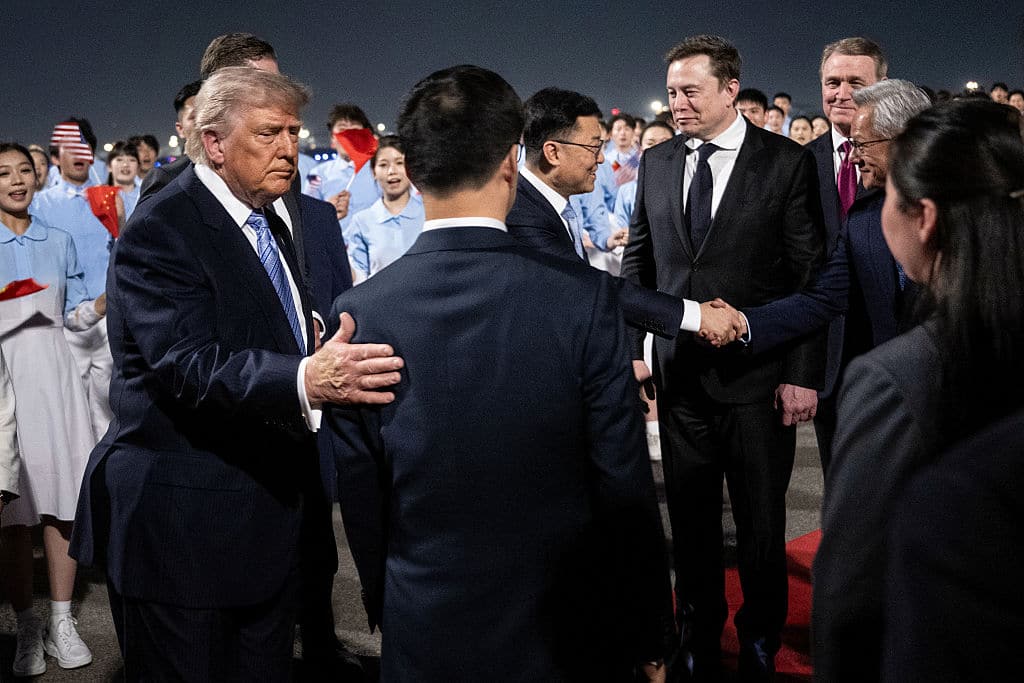
A president does not bring the chief executives of Apple, Tesla, Goldman Sachs, BlackRock, Boeing, Citigroup, Mastercard, Visa, Micron, Meta, GE Aerospace, Blackstone, Qualcomm, Cargill, Coherent, and Illumina to a foreign capital unless he is trying to say something.

What Donald Trump is saying, in the language of delegation lists and boarding manifests, is this: America means business.
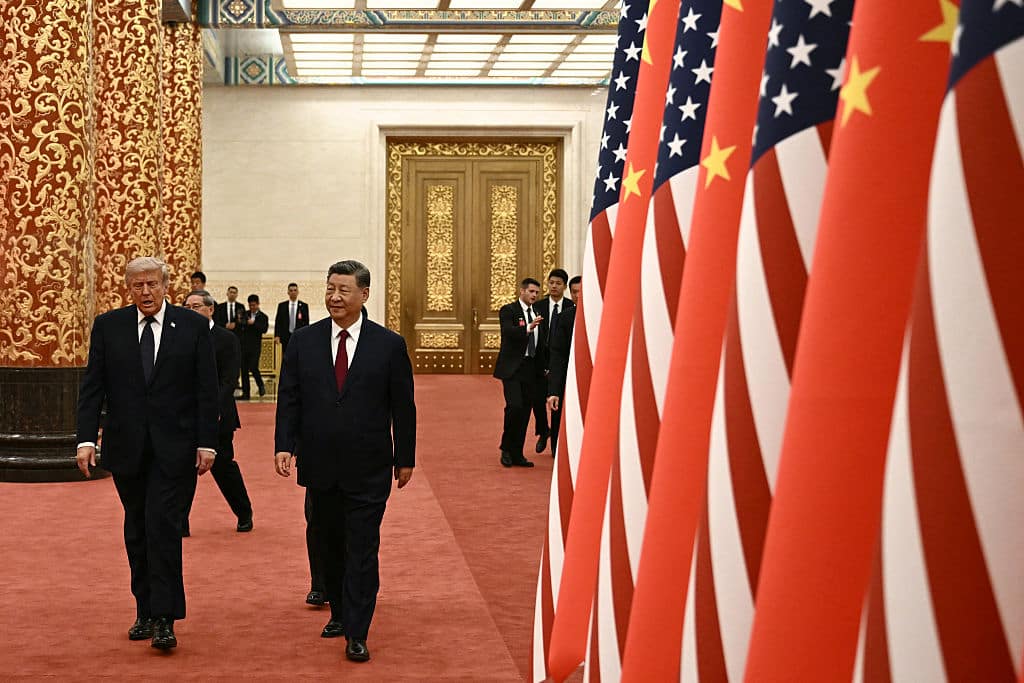
Air Force One touched down at Beijing Capital International Airport on Wednesday, greeted by a brass band and flag wavers as Trump descended the steps. The choreography was unmistakably deliberate — and so was the passenger list
It marks Trump’s first visit to China since 2017, arriving at a moment of heightened geopolitical and economic uncertainty, with the Iran war straining global markets, gas prices spiking, and Trump’s poll numbers at record lows.
Sources indicate Beijing views this summit as a singular opportunity to secure a more stable long-term relationship with its largest economic and military competitor. In other words, both sides need something from this room.
The agenda is a full house. Talks are expected to cover trade, Taiwan, artificial intelligence, and the war involving Iran. China feels confident enough to stand firm on key issues including sanctions, technology controls, critical minerals, and Iran. That is the diplomatic reality beneath the pageantry. Xi Jinping is not receiving guests from a position of weakness.
And yet the American side is not arriving empty-handed. The corporate delegation is, in effect, a walking argument for engagement — a living proof-of-concept that the two economies remain deeply, perhaps irreversibly, intertwined.
For Elon Musk, China is both a vital manufacturing hub and a massive consumer market. For Tim Cook, it is expected to be among his final major diplomatic acts before his September retirement, as he prepares to hand over Apple’s leadership to John Ternus.
Boeing has faced severe headwinds since Beijing raised import taxes on American goods to 125% last year, and negotiations for a major aircraft sale are reportedly ongoing. Senator Steve Daines, fresh off a congressional delegation visit to Beijing, offered a plain-spoken forecast: “We hope to see some kind of trade deals come out. I think it will be Boeing, beef and beans.”
The subplot worth watching is Nvidia. In a significant late-stage development, CEO Jensen Huang reportedly joined the presidential entourage after it was initially reported that he would not attend. His presence — or absence — is itself a statement about where the AI chip fight stands. When Huang was asked last week whether he’d been invited, he offered the kind of answer that is its own answer: “If invited, it would be a privilege. It would be a great honor to represent the United States.”
Notably, General Motors, Disney, and Alphabet — all companies with substantial Chinese interests — did not appear on the White House’s list. Their absence is its own form of signal.
What does it mean when a president assembles the commanding heights of American industry and flies them to meet the leader of a rival superpower? It means the old tools — tariffs, sanctions, strongly worded communiqués — may have reached their limits, and both sides know it.
Citigroup’s Jane Fraser put it plainly on Friday: engagement between the two economic superpowers is not optional. “We all need that engagement to be occurring.”
She is right. The question Beijing and Washington must now answer together is whether they can make it last.