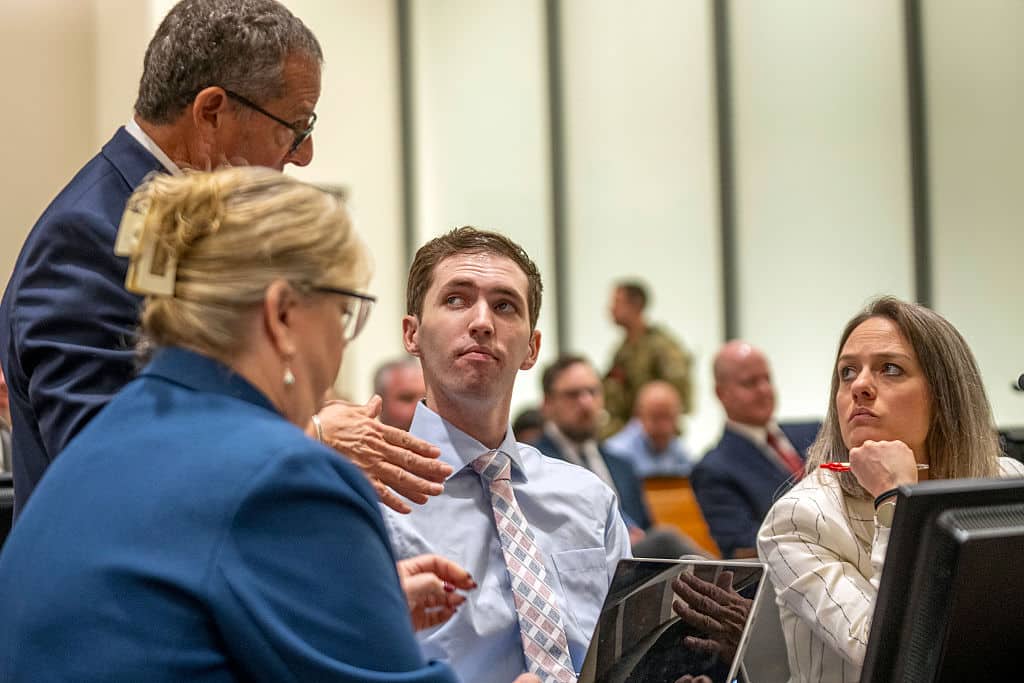
Charlie Kirk’s killer is going to trial. A Utah judge said so Tuesday: the evidence is there, the case moves forward, and Tyler Robinson could die for what he did.

That’s the news. Here’s what matters.
Judge Tony Graf didn’t hedge. He looked at what prosecutors laid out — the confession, the note left for a roommate, the rifle fired from a rooftop more than 400 feet from a stage where Charlie Kirk stood talking to a crowd of three thousand people — and he said: this goes to a jury.
All seven counts.
Aggravated murder chief among them.
The kind of charge that carries a needle at the end of it.
Robinson is 23. He pleaded not guilty, which is his right and means nothing yet. What means something is the argument prosecutors made to keep the death penalty on the table. You can’t fire a rifle into a crowd that size, Utah County’s Ryan McBride told the court, without knowing you’re gambling with more lives than the one you’re aiming at. Common sense, he called it.
He’s right. It is.
This is where the case gets its teeth. Not just did he do it — everyone in that courtroom already believes he did — but did he do it in a way that shows he didn’t care who else might have caught that bullet.
The judge decided yes. That’s the aggravating factor. That’s what keeps this a capital case instead of a life sentence with parole hearings every decade.
Nearly a year has passed since Kirk was shot dead at Utah Valley University, in front of students, in front of cameras, in front of the country.
A year of hearings, motions, arguments about whether TV cameras belonged in the courtroom.
A year in which the case became, for some, a symbol — of politics gone feral, of a country that can’t disagree without reaching for a scope.
For Kirk’s family, Tuesday wasn’t a symbol. It was a step. Their word, and the right one: an important step toward justice.
It’s not justice yet. It’s a trial date on a calendar. But it’s the first day this case stopped being argued in the abstract — evidence sufficient, evidence insufficient — and started being argued in front of the people who’ll actually decide it.
Robinson’s lawyers wanted to stop this before it started.
They didn’t get their wish.
Now they get a jury.