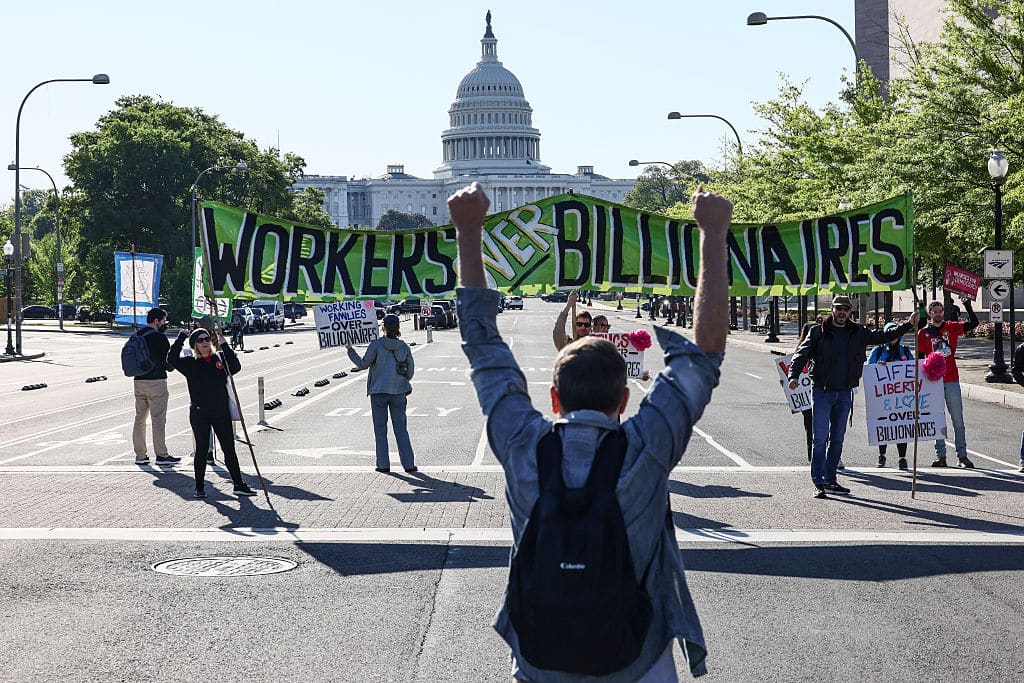
Today is May Day, the high holy day of international socialism, and across America, some 600 organizations have taken to the streets.

They have asked their fellow citizens to skip work, to skip school, to skip shopping — to register, in the old phrase, a refusal. Some 3,000 protests and events are planned.
The combined annual revenue of the groups behind them, according to a Fox News Digital investigation, runs to roughly $2 billion. That is a great deal of money for a movement that styles itself as the voice of the dispossessed.
What is striking about this May Day is not that the communists are marching. The communists always march on May Day; that is what May Day is for. The Communist Party of the USA has rallied workers to “rise against MAGA.” The Revolutionary Communist Party has called for dismantling what it calls the capitalist-imperialist system. The Maoist Communist Union has summoned its members to an Anti-Imperialist Contingent in New York. A constellation of groups — the People’s Forum, the Party for Socialism and Liberation, ANSWER Coalition, Code Pink — funded by Neville Roy Singham, an American tech millionaire who lives in Shanghai and promotes the line of the Chinese Communist Party, are out in force.
None of this is new. What is new is who is marching alongside them.

The California Democratic Party — which proudly notes that it is the largest state party in the nation, with more than 10 million members — is using its digital infrastructure to promote “Workers over Billionaires” rallies, including one at a street corner in Indio.
The Ohio Democratic Party Progressive Caucus is on the official organizers’ list for the “May Day Strong” coalition.
So are the Young Democrats of Moore County, North Carolina, and the Young Democrats of Wisconsin, and the Yuba County Democratic Central Committee.
In Newark, Ohio, the Licking County Democrats are hosting a rally at the courthouse, faithfully promoting the national mantra: “No Work No School No Shopping.”
Indivisible is in. MoveOn is in. The American Federation of Teachers is in.
At least 13 state and local Democratic Party affiliates are in.
This is what the analysts are calling a red-blue network, and the phrase has the virtue of being accurate.
The reds are the communists and socialists who have always been with us, in their small rooms, with their small newspapers, holding their small convictions with great fervor.
The blues are the institutional Democratic Party, which used to keep a polite distance from such company. The two are now appearing on the same flyers, promoting the same rallies, painting banners side by side at what the Party for Socialism and Liberation calls Liberation Centers in some 25 American cities. Members shuttle inside, painting placards, preparing their gear.
A Democratic strategist, Melissa DeRosa, sees what is happening and is willing to say so. The willingness of mainstream Democrats to align with extremist socialist groups, she told Fox News Digital, is a major reason the party is losing the center, and a major reason so many lifelong Democrats now feel politically homeless.
May Day, she said, has a proud history of honoring workers. But too many Democratic organizations have allowed that tradition to be hijacked by the activist fringe — by groups pushing what she called a fantasy agenda that has failed everywhere it has been tried.
She is right about the fantasy, and right about the failure, and right about the homelessness.
There is a kind of Democrat — older, sober, a union member perhaps, a churchgoer perhaps, someone whose grandfather voted for Roosevelt and whose father voted for Kennedy — who looks at today’s events with a particular sadness.
He understands that May Day, in its origin, was about the eight-hour day, about Haymarket, about real workers and real grievances.
He does not recognize the May Day of 2026, with its Maoist contingents and its Shanghai-funded propaganda outfits and its Liberation Centers. He looks at the list of organizers and finds the party of his life standing in formation with people whose ideas, soberly examined, he finds appalling.
The deeper question is how this happened.
Coalitions do not form by accident; they form because the parties to them have decided, at some level, that the alliance is worth more than the embarrassment. Somewhere in the Democratic Party, in 13 state and local affiliates and counting, a decision was made — quietly, perhaps, without much debate — that the energy and the foot soldiers of the far left were worth the cost of standing under their banners.
It is the kind of decision that looks shrewd in a planning meeting and looks different on the evening news, when the cameras find the hammer and sickle two rows back from the Democratic Party banner.
There is a phrase Americans used to use about the company one keeps. It applies here. A great political party, a serious one, the party of Truman and Humphrey and Moynihan, has business to attend to that is not the business of the Revolutionary Communist Party.
When it forgets the difference, the voters tend to remember.