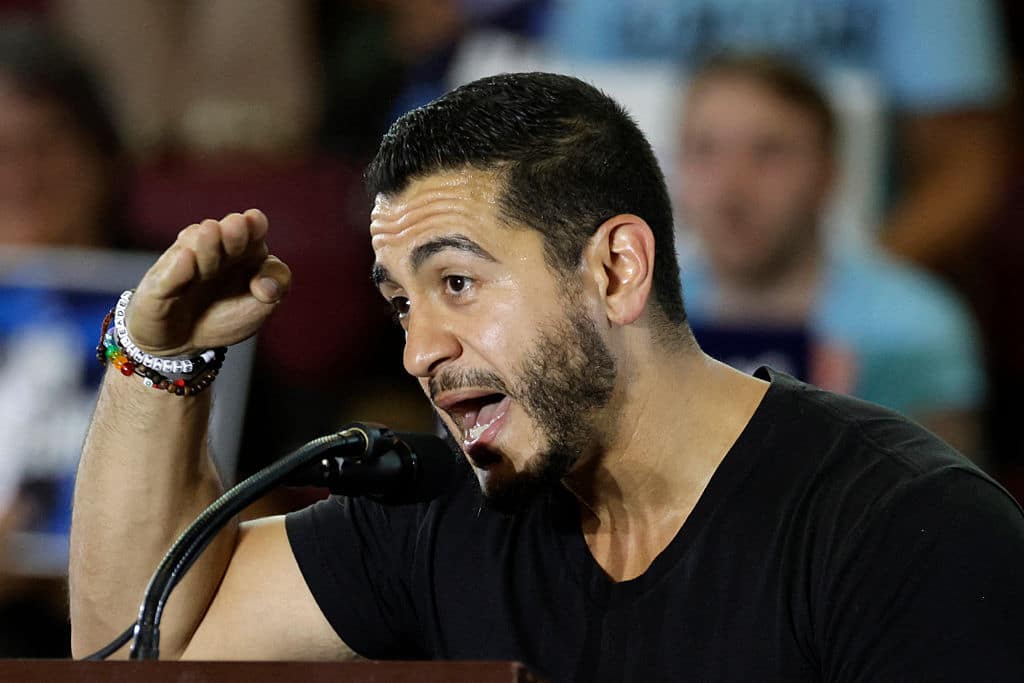
Abdul El-Sayed would like to be the next senator from Michigan. That means, among other things, asking Michigan voters to believe the man he is today matters more than the things he said a few years ago.

That may be a harder sell than he expected.
Old videos and podcasts have resurfaced in which El-Sayed, the Democratic nominee, took aim at some fairly familiar pieces of American life: Fourth of July fireworks, the Second Amendment, the southern border and even football.
None of these comments, taken alone, is likely to decide a Senate race. Taken together, though, they begin to form a picture.
In a July 2024 video, El-Sayed urged Americans to rethink the use of fireworks on Independence Day. He cited pollution, injuries, frightened animals and the effect loud explosions can have on veterans suffering from post-traumatic stress disorder.

The segment was titled, “Fireworks just aren’t worth it.”
There is a practical argument there. But politics is rarely only about the practical argument.
The Fourth of July is not simply a municipal noise-management problem. It is one of those old American rituals — loud, imperfect, slightly ridiculous and deeply loved — that politicians tamper with at some risk.
Then there is the Second Amendment.
After the 2023 school shooting in Nashville, El-Sayed wondered aloud whether the Constitution itself ought to be rewritten.
“What if we tweaked the Constitution, amended the amendment, and instead of the right to bear arms, we change it to the right to have health care?” he asked.
It is the kind of line that plays differently in a progressive podcast than it does in a statewide Michigan election.
The same is true of immigration.
In a 2022 video, El-Sayed said Republicans “love to flog” the southern border and argued the issue did not even rank among the five most important concerns affecting Americans’ lives.
Republicans will surely remind voters of that one.
And then there is football, which in Michigan is not merely a sport so much as a civic language.
In a 2023 podcast, El-Sayed described football as connected to a “particularly masculine and oftentimes toxically masculine culture” and wondered whether there could be a version of the game that was truly “ethical” and “safe.”
Later, he went further, saying episodes in American history including the destruction of Native Americans and the trans-Atlantic slave trade were “echoed in the ethos of football.”
This is an unusual thing to say anywhere. It is an especially unusual thing to say if you later plan to ask Michigan voters to send you to the United States Senate.
El-Sayed’s campaign now says these remarks are being cherry-picked and do not reflect his current beliefs.
“Abdul is the former captain of his high school football team, loves Michigan football on Saturdays, and celebrates the Fourth of July with fireworks like the next Michigander,” his campaign said.
Fair enough.
People change. Politicians change. Sometimes they even say plainly that they were wrong.
But that creates the question El-Sayed will probably have to answer between now and November: Which beliefs changed, and why?
He narrowly defeated the more moderate Rep. Haley Stevens in the Democratic primary and now faces Republican Mike Rogers in a race expected to be highly competitive.
Rogers’ campaign has already begun portraying El-Sayed as too far left for Michigan.
The old clips make that argument easier because they touch something larger than policy. They touch temperament.
Voters often forgive an unpopular position. What they are less certain about is a worldview — particularly one that seems to look at ordinary American traditions and find, first, something suspect.
Fireworks. Guns. Football. The border.
El-Sayed’s problem may not be any one old quote.
It may be the accumulation.