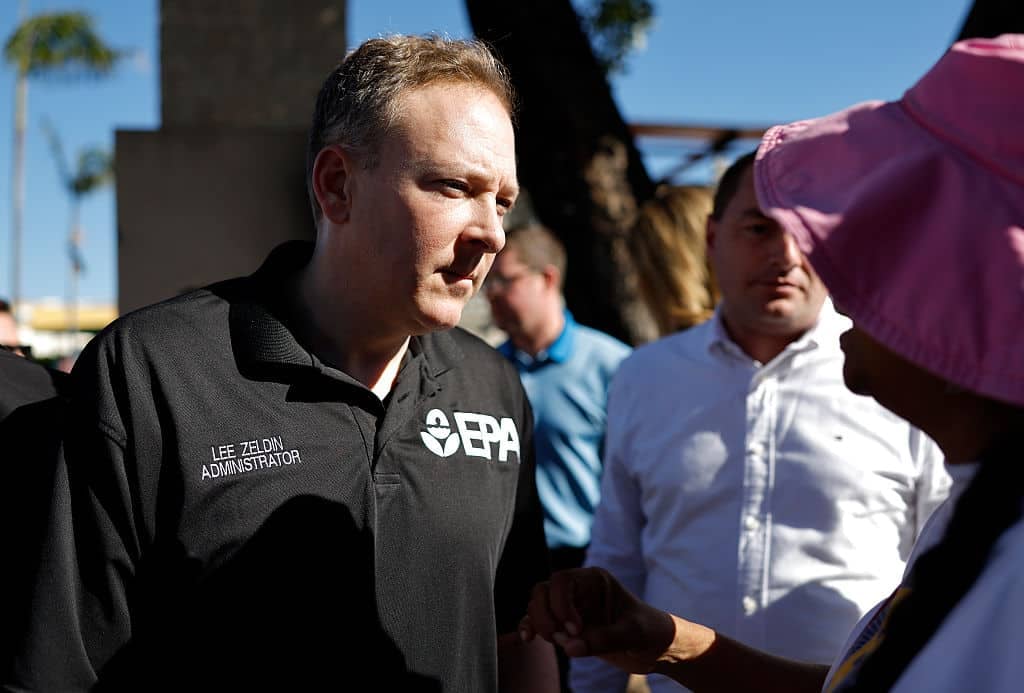
A certain Washington drama is back onstage, with a familiar prop in the spotlight: a scientific determination from 2009 that became, in time, a legal foundation.

The Trump Administration is preparing to repeal that Obama-era determination — the EPA’s “endangerment finding” — and U.S. officials say it could become the most far-reaching rollback of U.S. climate policy to date.
The endangerment finding concluded that six greenhouse gases pose a threat to public health and welfare. It was, in effect, the prerequisite that enabled the agency to regulate greenhouse-gas emissions from new motor vehicles under the Clean Air Act.
And now it is being targeted.
“This amounts to the largest act of deregulation in the history of the United States,” EPA Administrator Lee Zeldin said in an interview.

Administration officials say a final rule — expected to be made public later this week — would remove federal requirements tied to greenhouse-gas standards for motor vehicles.
Along with the associated compliance programs, credit provisions, and reporting rules.
Officials say the change would not apply to rules governing emissions from power plants and other stationary sources such as oil-and-gas facilities. But they also acknowledge that rescinding the endangerment finding could create an opening for future efforts affecting those sectors.
Supporters of the move have been around for years. The fossil-fuel industry and other critics of federal climate mandates have long argued that the regulations are costly and burdensome.
Trump, for his part, has framed expanded reliance on domestic fossil fuels as central to economic and national security — and as a lever to lower energy prices.
“More energy drives human flourishing,” Interior Secretary Doug Burgum said in an interview. “Energy abundance is the thing that we have to focus on, not regulating certain forms of energy out.”
Opponents are not exactly subtle, either.
Environmental groups say they will challenge any rollback in court, and litigation could take years. The EPA’s earlier proposal to rescind the finding drew heavy public engagement, including hundreds of thousands of comments.
The Environmental Defense Fund warned that rolling back the endangerment finding would “eliminate some of our most vital tools to protect people from the pollution that causes climate change,” and argued it would steer the country toward dirtier air.
This move was not sprung in the dark.
On Inauguration Day last year, Trump signed an executive order directing the EPA to assess whether the endangerment finding should remain in place. And in 2025, the agency formally moved with a rescission proposal and related vehicle-rule reversals now heading toward a final decision.
What’s coming is not merely a policy shift.
It’s a test of what, in America, is bedrock—and what can be moved.